Perception and Precedent: Intro
Before the Meeting. A collection of notes on organizing, law, and the generations who built the reach.

When I was a kid, a school district decided I did not need the services I needed. My community sued. We won. That is not the lesson.
The Individuals with Disabilities Education Act, a federal law passed long before I was born, a law I had never heard of and could not have pronounced, said I was owed the services. What I remember is not the law. What I remember is my mother’s face reading a letter. What I remember was the countless days I’d spend alone behind a toolshed due to the overstimulation in class, or dashing outside the Unitarian youth group the second I saw an opening. What I remember is that a piece of paper written by a person in an office I would never see could decide whether I would learn to read the way other children learned to read.
The lesson came later, probably in college, when I understood that the law had been sitting on the books the entire time, and what my family had done was walk up to a shelf where something had been placed decades ago by people we would never meet, lift it down, and brandish its authority. The law did not come to us. Instead, we went to the law. And, we only knew how to do that because generations before me had been building the particular kind of reach it required.
That reach is what I want to write about.
I should say, before anything else, that this will be a series about organizing, and it is going to argue with the tradition of organizing that most people I work with were trained in. One that has us trying to find the “common sense” reality in charts like these.
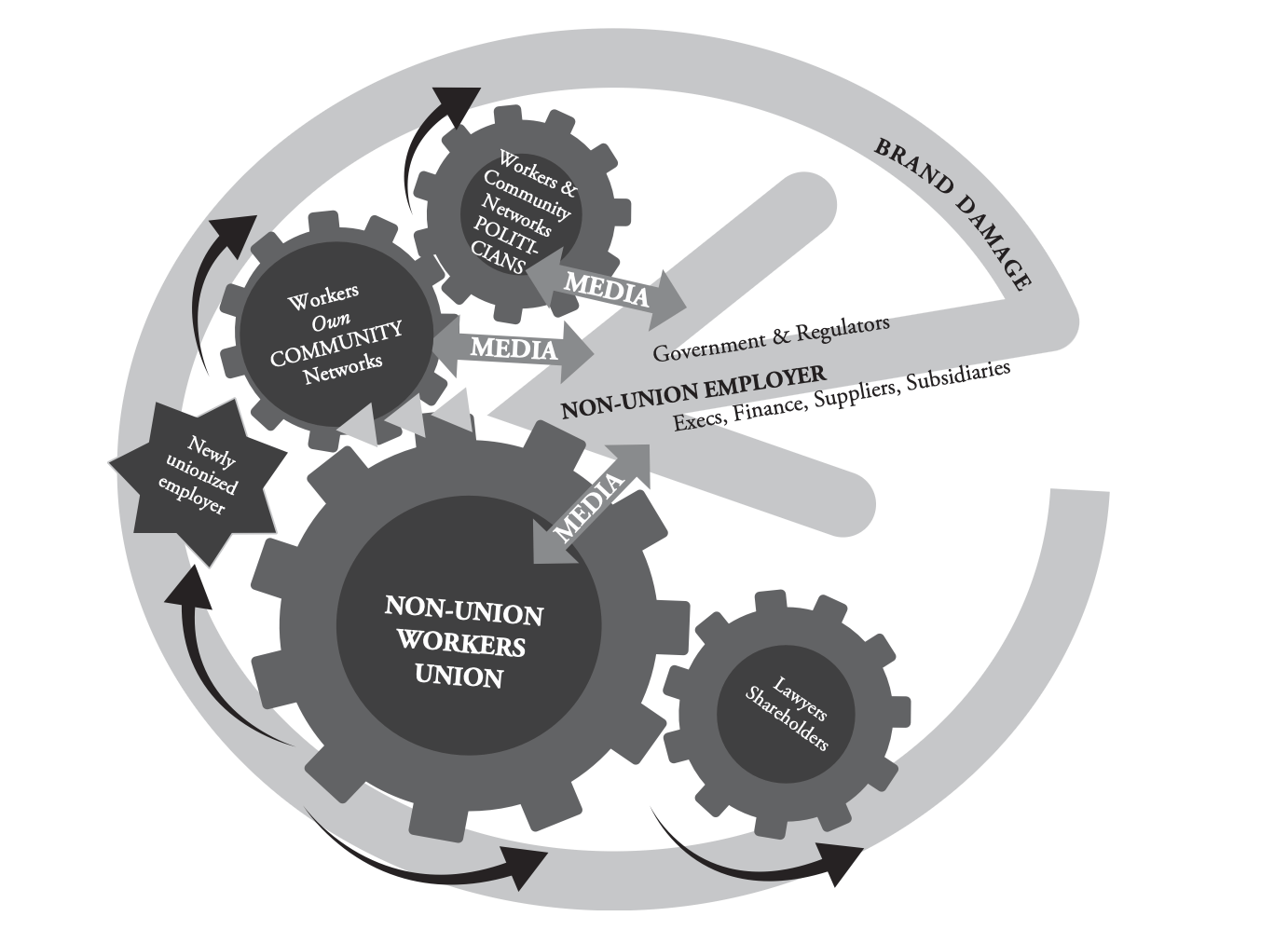
The tradition I mean begins, in the American imagination, with Saul Alinsky and runs through Fred Ross and the IAF and a thousand neighborhood campaigns after. It is a tradition I respect. It is a tradition I was raised in. It is also a tradition that has spent seventy years looking in the wrong place for political power. It locates power in the moment of confrontation (the meeting, the action, the target), and it tends to treat the community before the meeting as raw material to be activated towards the machinations of a broader campaign. In other words, it is a theory that starts only upon the introduction of the organizer or politician.
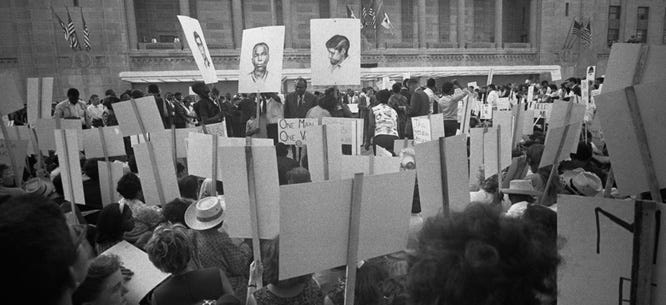
But political power does not start when the organizer arrives. It starts decades earlier, in the quiet economies immigrant and working-class communities build in order to be in a position to have a meeting at all. Those economies are what my family is. They are what my family taught me. They are what the dominant theory of American organizing cannot see.
Let me show you what I mean.
My relationship with the living room mirror is complex. Around its frame lies a constellation of family portraits, tíos and tías I never met, their images printed in sepia tones that seem to absorb the light rather than reflect it. Old suits hang loose from their shoulders, beside women in dresses whose seams look tired but are withstanding their uncoiling through a network of threading and interlocking fingers holding them all together. Their faces are a combination of pride and weariness, carved with the patience of a country that was learning to endure itself.
I end the meditation by staring at her. My tatarabuela, my great-great-grandmother, a curandera named Rupe. She kept the older medicine alive in a region that, during the Porfiriato, had been told the older medicine was embarrassing. Told that the railways cutting through the mountains and the European medical schools in Mexico City were the future, and she and her knowledge were the past. She ignored them. She sat under an orange tree outside Tijuana every evening, gardening until her fingertips turned the color of earth, and listened to the women of the neighborhood as they came down the road one at a time with whatever they could not carry alone.
There is a Carmen Lomas Garza etching called La Curandera that renders that kind of evening almost exactly. No halo. No mysticism. A woman at work. The first time I saw it, I was surprised by how ordinary it looked. A closer look reveals a child sitting pensively outside, waiting for guidance.
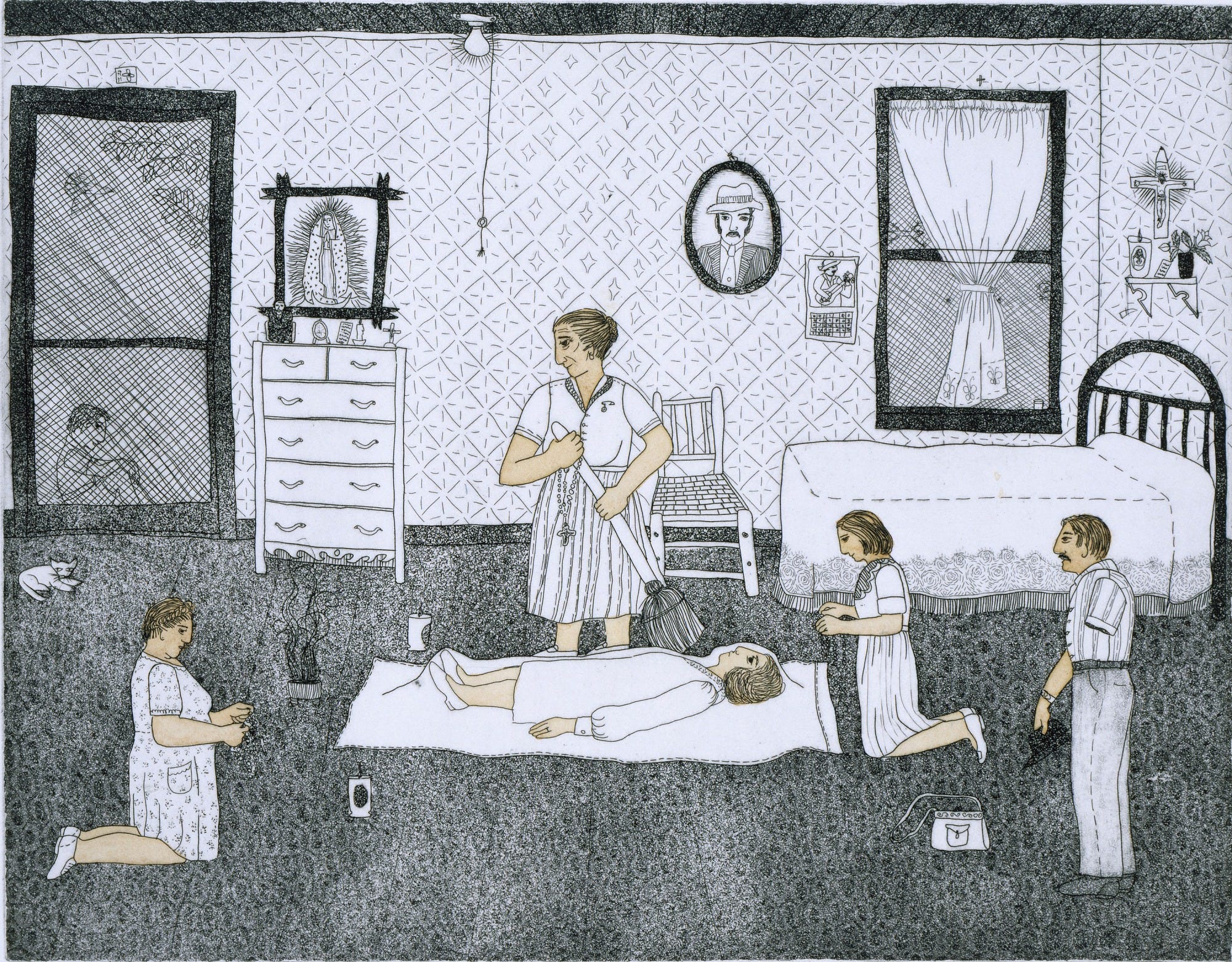
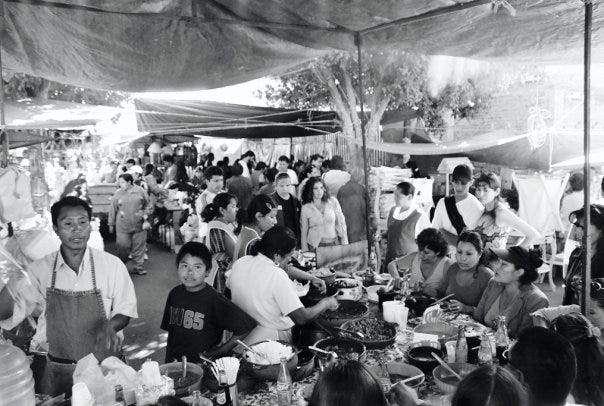
I suppose that was my father, who, as a boy, would walk to the mercado and buy her herbs and bring them back. They lived at the center of town, surrounded by mercados and fruit and vegetable vendors. He tells me she took them from his hand the way you take a tool, not the way you take a gift, and said: “Tienes que respirar el dolor del mundo, mijo. Pero no dejes que te mate.” You have to breathe the world’s pain. You can’t let it kill you.
Rupe helped raise the nine children that my great-grandparents had. I have heard from many of my tía-abuelas about how she was the last one awake every night and the first one up every morning, that she ran on the kind of sleep women raising nine children alone learn to ration, that the patience the neighborhood saw under the trees of her garden was the patience that was left over after she had already spent most of it on her own kids.
Call that what you want. I choose to call it organizing. Not because the word flatters her. Because the word is fundamentally incomplete without her in it.
Her daughter-in-law was named Ata, and Ata is the one American organizing theory is built to miss entirely.
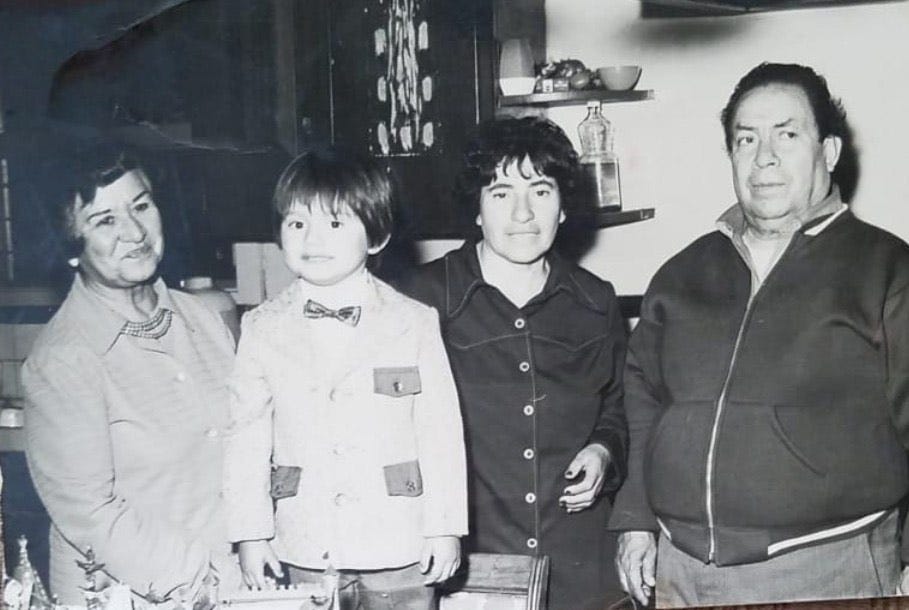
Ata did not inherit the folk medicine. Ata worked in real estate, in rooms that were not built for Mexican women in the middle of the twentieth century, literally disguising herself as a man at times so she could navigate the all-male Mexico City business world, and she did it well enough to fund a clinic. This story is important, I promise.
My great-grandfather, Papapa, went to UNAM and became a doctor, surrounded by portraits of European kings whose gilded frames mocked him from every wall. My uncle said he was mocked in person too: for his accent, his shoes, the stubborn dignity that refused to bend. He never answered any of it. After obtaining his degree, he moved north and opened an indigent-care clinic on Avenida Revolución in Tijuana, treating men and women who would, decades later, be rebranded as maquiladora labor, injured on shift floors their employers were not going to pay to treat, paid in gratitude more often than pesos. He is the one the neighborhood remembered. He is the one some still call doctorcito, a prayer disguised as a nickname.
But the clinic existed because of Ata’s entrepreneurship and labor.
Rupe carried the knowledge. Ata built the capital. Papapa delivered the care. Three generations of one family, running a distributed health system for poor people in a border city, because the formal system was not going to. The men who wrote the organizing manuals in Chicago in 1971 were not looking at this. They were looking for the moment when a meeting got heated. They missed the forty years before the meeting.
That is the thing I want this series to correct. Not in theory. In the actual names.
I should say, because the ancestor-worship note in pieces like this one is usually the tell that a writer is not being honest, that none of this was gentle. The herbs guided Rupe. So many lessons in the garden. They have marked the health of three generations since. Papapa charged his patients far less than he should have for forty years, a choice that was only possible because Ata was running a second economy to keep the family afloat. What the neighborhood remembers as his generosity was also her ledger, her calculation, her call. And Ata herself. I do not have a single letter in her handwriting, a single photograph of her at her desk, a single recorded sentence of hers about the work. The neighborhood remembers the doctor. The family remembers the doctor. History remembers the doctor. And somehow, a frontier away, we are left with only a conciliatory story of self set in a land that no longer wants to work with us.
I am saying this because the registers most writers slip into when they write about their Mexican grandmothers are reverence and pity, and both are where political analysis goes to die. You cannot argue with a saint. You cannot strategize with a victim. Rupe, Ata, and Papapa were working adults who made judgments, ran tradeoffs, ran out of patience, and argued with each other. If I do not treat them that way, I can only light candles, and I want to carry their method forward, not their haloes.
Papapa left our family a principle I have been turning over most of my adult life: you don’t fight your way in. You build a door.
It is a beautiful sentence. It is also, in certain rooms, an unforgivable one. There are fights that will not wait for a door to be built. There are doors that were never going to exist, no matter how long you stood there with the wood in your hands. I loved him, and I love the line, and I am arguing with both.
That argument, build the base first and organize on top of it, and argue with the base when the base is wrong, is the reason I am choosing to write about the law and organizing.
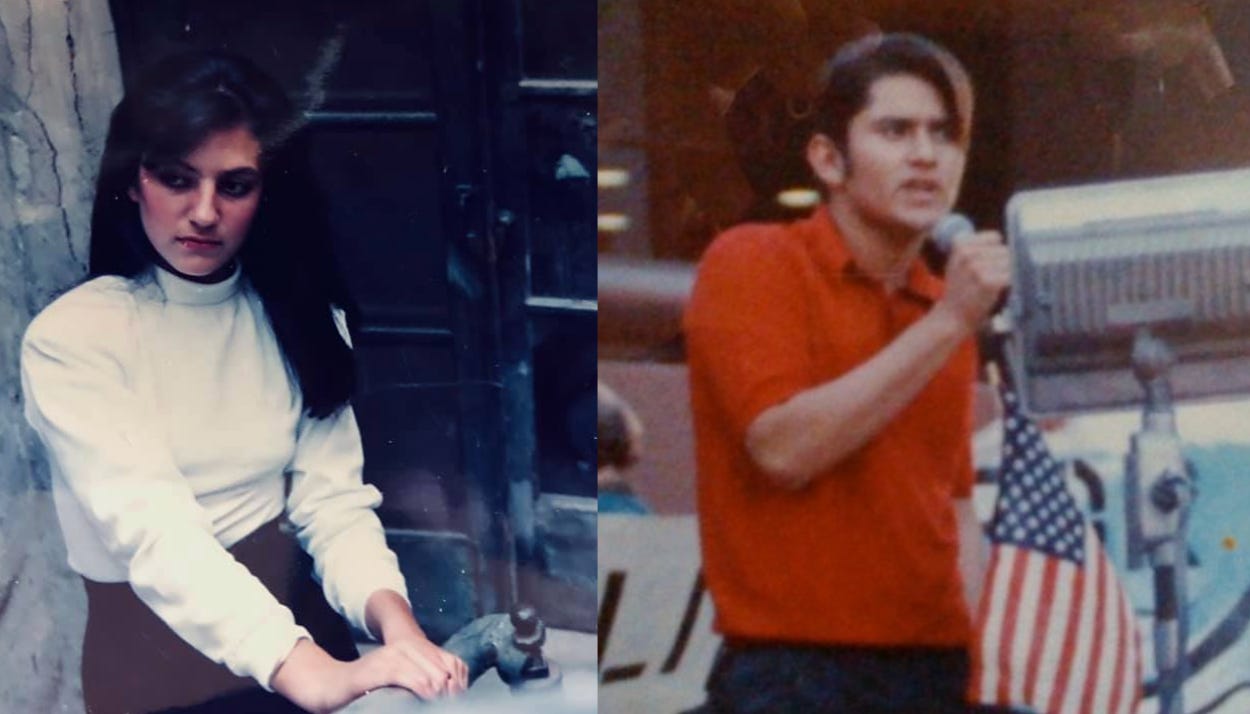
My parents met in a Chicano studies class at a community college. Probably the most Chicano/activist-coded love story ever. Both immigrants, both undocumented. They bonded over their passion and commitment to the movement’s vision. That story is the kind of thing people put in bios, and it is useless. What I mean is that they met in the particular early 1990’s version of it where the marches had thinned out compared to the 60’s, and the question nobody wanted to ask out loud was what you were supposed to do on a Tuesday, in February, when the movement that had been your whole life was not paying anyone’s rent. My father was performing political poetry and organizing cross-border boycotts from Nestor. My mother was earning her bilingual teaching credential in San Diego. They were, by every measure the movement used to measure itself, doing the work.
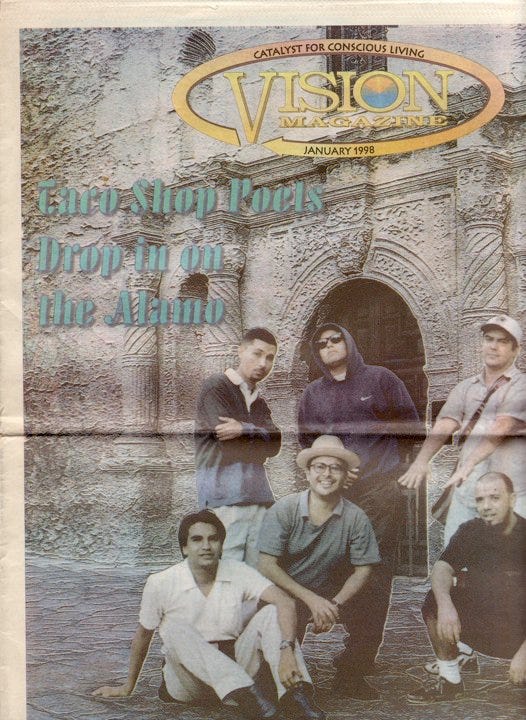
The year I was one, or maybe two, they sat at a kitchen table and decided to stop. Not stop organizing— nobody in my family has ever stopped organizing, but stop doing it as the thing that was supposed to feed us. My father gave up his passion as a traveling spoken word poet and went back to fully commit to his work as a teacher. My mother, who was already teaching, doubled down and finished her bilingual credential and her Master’s. I have asked both of them, at different points in my life, what that conversation was like, and I have gotten two different answers, which is how I know it was a real conversation and not a story they rehearsed afterward. My father holds a certain frustration, a dissolution of his impact on his community. My mother remembers it as a logical step. They are both right, and the fact that they are both right is the thing I want to write about.
Because what Papapa’s line— you don’t fight your way in, you build a door— does not tell you is what to do in the decades when the door is half-built, and we are at risk of losing our home. Rupe could sit under the orange tree because Ata was running the books. Papapa could charge his patients a fraction of what the work was worth because the family economy around him absorbed the difference. My parents inherited the principle without inheriting the infrastructure. There was no Ata in their generation. There were only the two of them, and a baby, and a decision about whether the door-building was going to be done on evenings and weekends for the rest of their lives, or whether it was going to be the thing that broke them.
They chose evenings and weekends. My mother has spent more than two decades in a bilingual public school classroom, which, after California passed Proposition 227 in 1998 and tried to legislate her entire pedagogy out of existence, became a different job than the one she had trained for. She kept doing it, thanks to a narrow waiver provision that bilingual education advocates fought to keep usable, walking Spanish-speaking parents through a paperwork process designed to discourage them, so that dual-immersion classrooms like hers could survive as the law's reluctant exceptions. She did it in English when she had to and in Spanish when she could, and she did it under a law written by people who had decided, in a room she was not in, that the children in front of her would learn better if the language their grandmothers spoke was treated as an obstacle. Proposition 227 is a law that was lifted from the shelf and used against a community. My mother’s classroom was where that particular act of lifting arrived, wearing the face of a curriculum directive.
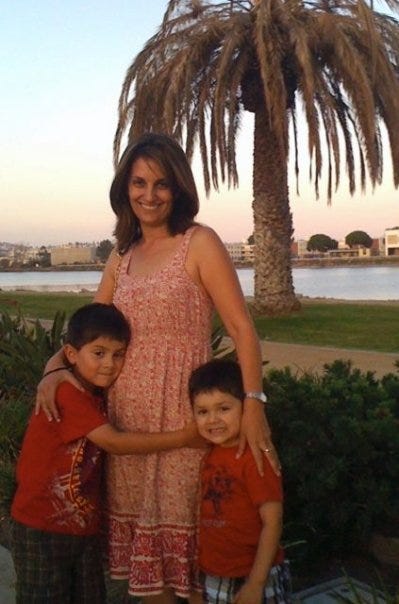
One building block of my life has been a commitment to community work. I saw this play out every day with my mother, as both my brother and I had to stay countless hours after school, the same Title 1 school where my mother taught, as she graded the same stack of papers twice, once for the content, once for the language, planned the next day's lessons in two registers, and called families whose kids needed something the school day had not been long enough to give them. My brother and I would sit on the carpet and help her assemble what we could, learning, without anyone having to name it, that the work did not end when the bell rang. That is where I understood, before I had words for it, what my parents had decided at the kitchen table. They had not given up the movement. They had folded it into the hours that were not on anyone's clock, and the political orientation that had brought them together in a Chicano studies class did not disappear when it stopped paying their rent. It moved into the unpaid hours. It has been there ever since.
That is the thing the grandparent generation did not have to reckon with in the same way. Rupe’s antagonist was a Porfiriato that wanted her knowledge to disappear by ignoring it. My mother’s antagonist was a ballot initiative that wanted hers to disappear by outlawing it. Both are forms of erasure. Only one of them has a publicly legitimizing statute number. And the difference between those two forms is the reason I keep coming back to the law, not because the law is where the fight lives, but because the law is now one of the terrains the fight has moved onto, and a family that knows how to build a door but not how to read a statute is a family that will keep finding the door has been rezoned out from under them.
One year, in the middle of all of this, we moved into a house where a man on our block greeted us, on the first day, with a single question: How can you afford this house?

For context, one year we moved into a house in the Mid-City region of San Diego, an area that can match Queens in its demographic and linguistic diversity. I can’t imagine any other reason why such a question was asked… How can you afford this house? That sentence itself is a reflection of policy. It is the accumulated weight of redlining, of racial covenants, of zoning decisions made in rooms nobody in my family was in. He did not invent the question. He inherited it the way I inherited mine. A policy does not stay in the room where it was written. It walks out the door, rides home in a neighbor’s car, and arrives at your house on a Tuesday afternoon wearing a neighbor’s face. The question at our door was not one man’s opinion. It was the zoning map speaking.
My family’s lawsuit was not the first time a Mexican-American family in San Diego County had to go to court to make a school do what the law already required. In 1931, Roberto Alvarez’s parents and a whole neighborhood sued the Lemon Grove school board for trying to segregate their children onto a separate campus. They won. Álvarez v. Lemon Grove is the first successful school desegregation case in American history, twenty-three years before Brown v. Board, and almost nobody outside Chicano studies has heard of it. I wrote a paper on it in college. I did not understand, while I was writing it, that I was writing about my own inheritance. I do now.
Two years into student organizing, I sat in a committee room watching a disabled student testify about sleeping in her car because the university’s housing office had told her the accommodations she needed were unavailable and would remain so. The administrator she was speaking to was sympathetic. I believed that the administrator was sympathetic. I also watched her look down at the document in front of her and realize, in real time, that she did not have the authority to fix what the student was describing. The authority lived somewhere further up. In a statute I had not read. Written by people I would not meet, let alone influence.
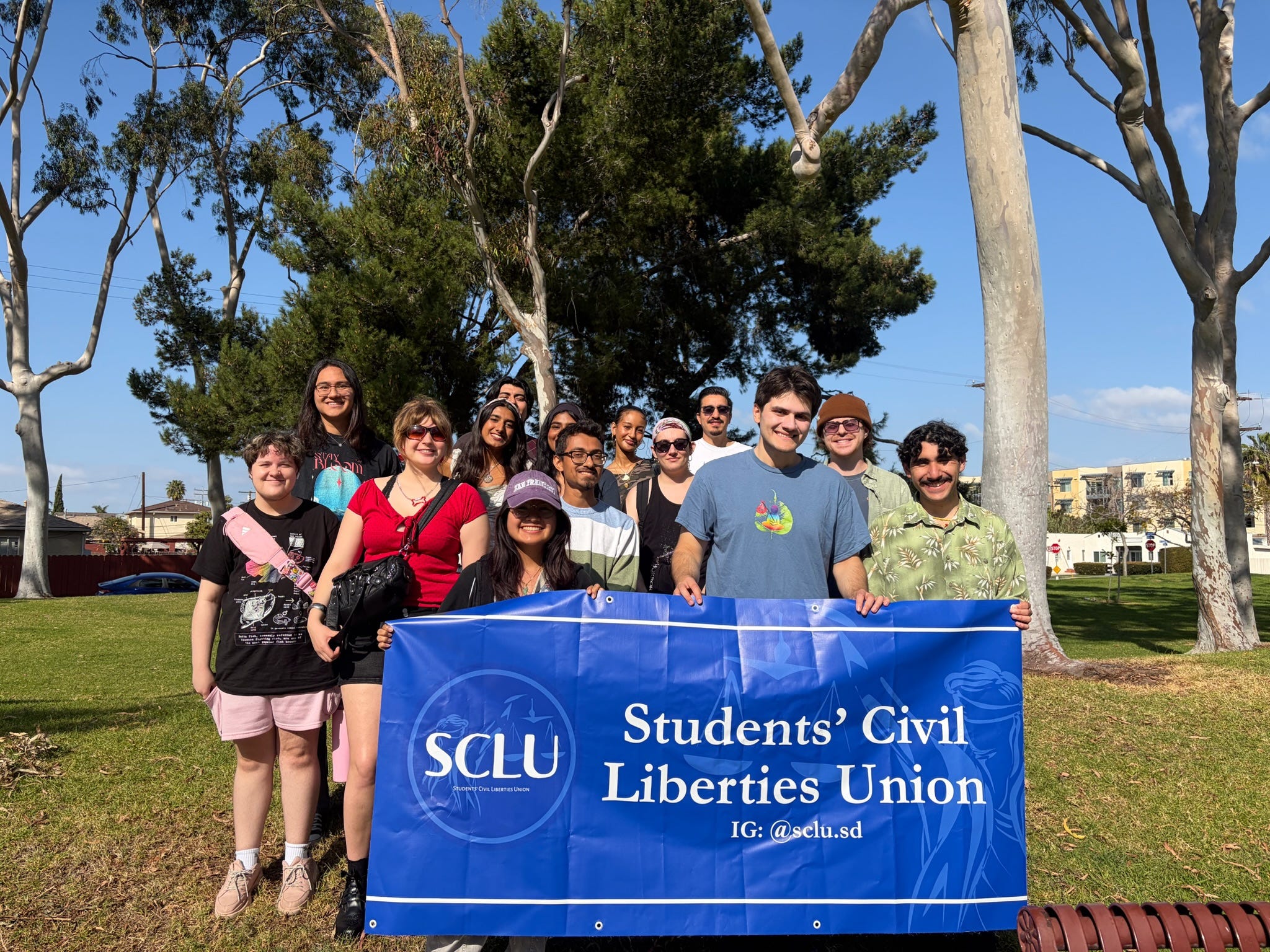
Those stories led me to co-found the Students' Civil Liberties Union with my closest friends. Most nights, I am trying to think up ways to raise money for our organizers, up late writing briefing memos about ICE detention facilities that the people running them would prefer we did not talk about. The work is necessary. I am not going to stop doing it. But I have started to understand that the meetings and the rallies and the hundreds of public comments do not, on their own, rewrite the statute. Somebody has to do that part, too. So I tell myself that I am going to stick to the work, and that the next form the work takes is going to require me to be able to read a statute. Law school because somebody in the fourth generation needs to be able to walk up to the shelf and lift the law down. Not because the law is going to save us. The law has almost never saved us. Because Rupe's knowledge, Ata's capital, and Papapa's practice need a fourth piece, and the fourth piece is someone who can read the statute that the administrator was too junior to override.
I suppose that is what this series is.
It’s an attempt to say that the story is not the decoration of politics. The story is the politics itself, or rather, the story is the instrument by which a community comes to know what it knows, and without that instrument, there is nothing for a law or a federated action or a lobbying memo to be in service of. Again, Rupe's evenings were not content. They were the long, arduous, unhurried work of turning private pain into a shared account, and everything my family built afterward, the clinic, the ledger, the lawsuit, the education I’ve inherited is only possible because she had done that work first. We are living now in an age that has mistaken the speed of a story for the strength of one, that measures reach in seconds and mistakes a feed for a neighborhood.
What I keep returning to is that none of this is light. Rupe's lungs, Ata's missing letters, my parents' kitchen table, the house we would die to keep, the statute that arrived at my mother's classroom wearing the face of a curriculum directive, the material conditions have always been there, pressing down, and they are pressing down harder now on a generation that inherited the principle without the infrastructure. I am not going to pretend the weight is not real. It is real. It is why so many of us are tired in a way our grandparents would recognize, and our algorithms cannot. But the thing I have come to believe, watching my family and watching the movements I have worked inside, is that the spark does not go out. It gets buried under the hours and the bills and the fifteen-second clips that ask us to feel something and move on, but it is still there, the same fire Rupe exhaled under the orange tree, the same fire my mother carried into a classroom the state had tried to legislate shut.
The work now is to rekindle it, and the only tool I know of that is honest enough to do that work is the story of self, not the polished version, not the one built for an algorithmic feed, but the harder one, the one that names the cost alongside the inheritance, the ledger alongside the legend. That is what this series is trying to be. A place where we tell each other the true version of where we come from, slowly enough that the telling itself becomes the infrastructure, so that when the next moment comes to lift the law down from the shelf, there is a community underneath it that remembers what it is for, and why we ever started reaching in the first place.
Hence, each essay will begin with one lived moment (mine, my family’s, someone else’s) and work backward until we reach the policy that produced it. Sometimes the policy will be famous. Sometimes it will be a municipal code nobody has heard of. Sometimes the essay will end with an action item. Sometimes it will end with a sentence I cannot yet write.
Because you have to breathe the world’s pain. You can’t let it kill you. I am still trying to figure out what she meant. But together, we just might.